



Can Cartridge Heaters Be Customized? How to Customize?

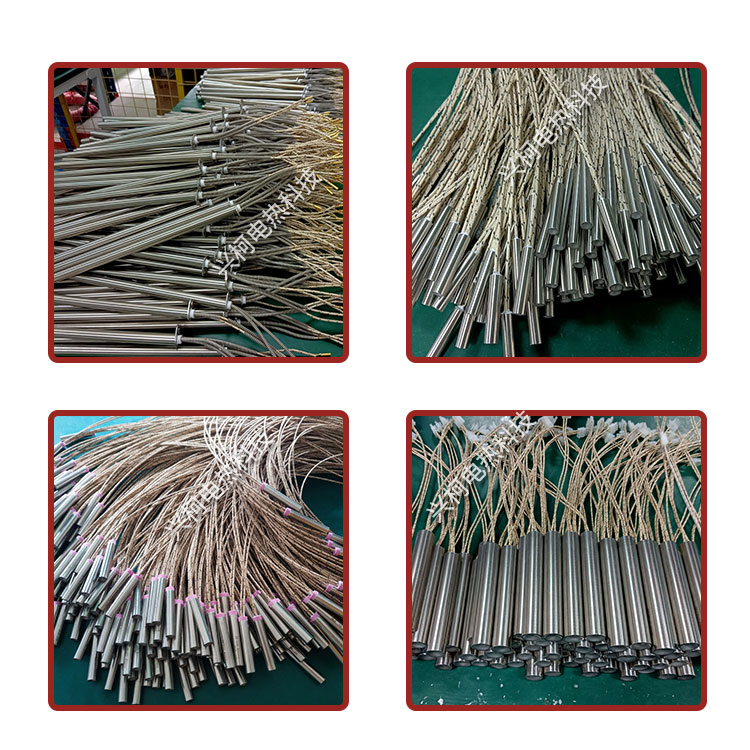
Yes. In most cases, cartridge heaters are fully customized according to requirements.
Cartridge heaters belong to non-standard industrial products. Standard specifications only suit general applications. For special conditions such as non-standard mold hole diameters, limited installation space, high-temperature environments or corrosive working conditions, customization is essential to ensure perfect dimensional fit, reasonable power density and long service life.
To customize, you need to provide the manufacturer with the following core parameters. The more detailed the communication, the better the product matches your application.
1. Core Customization Parameters for Cartridge Heaters
You may confirm your requirements item by item as below:
Size & Shape
– Diameter: Determined by the mounting hole. Negative tolerance is normally adopted (e.g. 9.9mm heater for 10mm hole) for tight fitting. Common range: Φ5.5mm – Φ30mm.
– Length: Clarify separately the heating section length (must be fully embedded in the heated object) and overall length (including cold end and lead root). Common range: 20mm – 2000mm.
– Shape: Standard straight tube; customizable into U-shape, L-shape, W-shape and special profiles to fit limited installation space.
Material & Temperature Resistance
– Sheath Material:
304 (general use), 316L (weak acid & alkali resistance), 310S (high temperature air firing, resistant to 850-900℃), Titanium tube (strong acid & alkali resistance), Incoloy 800/840 (severe high-temperature working conditions).
– Internal Material: High-purity magnesium oxide as standard; modified magnesium oxide for high-temperature requirements. Nickel-chromium wire such as NiCr 2080 is preferred for longer service life.
Electrical Performance
– Voltage: Standard 220V / 380V; customizable from 12V to 660V.
– Power: Calculated based on size and working conditions, with surface load (W/cm²) as the key control index. The manufacturer will provide professional suggestions to keep it within a safe range.
Lead Wire & Mounting
– Lead Type: External lead (standard, rigid root) or internal lead (flexible root, higher ambient temperature resistance).
– Lead Length: Standard 200mm, customizable to any required length.
– Mounting Method: Confirm if thread or flange connection is required, together with thread specifications.
Optional Function
– Temperature Sensor: Embedded Type K / Type J thermocouple available for precise temperature control.
2. Cartridge Heater Customization Process
The standard customization procedure includes 4 steps, with lead time ranging from several days to weeks depending on complexity:
1. Requirement Communication: Provide the above parameters and application scenarios (e.g. hot runner, water tank, oven) for feasibility evaluation.
2. Solution & Design: The manufacturer designs and sends technical drawings for confirmation. For complex projects, schematic drawings or simulation data will be offered first.
3. Sampling & Testing: After drawing confirmation, prototype samples will be made (normally with sampling fee). You can conduct installation and heating tests to verify all performance parameters.
4. Mass Production: Once the sample is approved, mass production, quality inspection and delivery will be arranged.
3. Complete Customization Example
Custom single-end cartridge heater with internal lead for hot runner application:
– Size: Diameter 9.9mm for 10mm mounting hole; heating length 150mm; overall length 200mm.
– Material: 310S stainless steel sheath; pure nickel internal lead with 300mm length.
– Electrical: 220V, 400W. After professional calculation, surface load is about 8-10 W/cm², within safe range for mold heating.
– Mounting: No thread; fixed by tight interference fit with the mounting hole.
Summary
Clear parameter confirmation and standardized process are the key to customized cartridge heaters. If you have confirmed mounting hole size, installation depth and working conditions, you can contact us directly. We will assist you with power calculation, material selection and lead type recommendation, avoiding shortened service life or product damage caused by incorrect parameters.