



What are the specific selection steps and key parameters for cartridge heaters

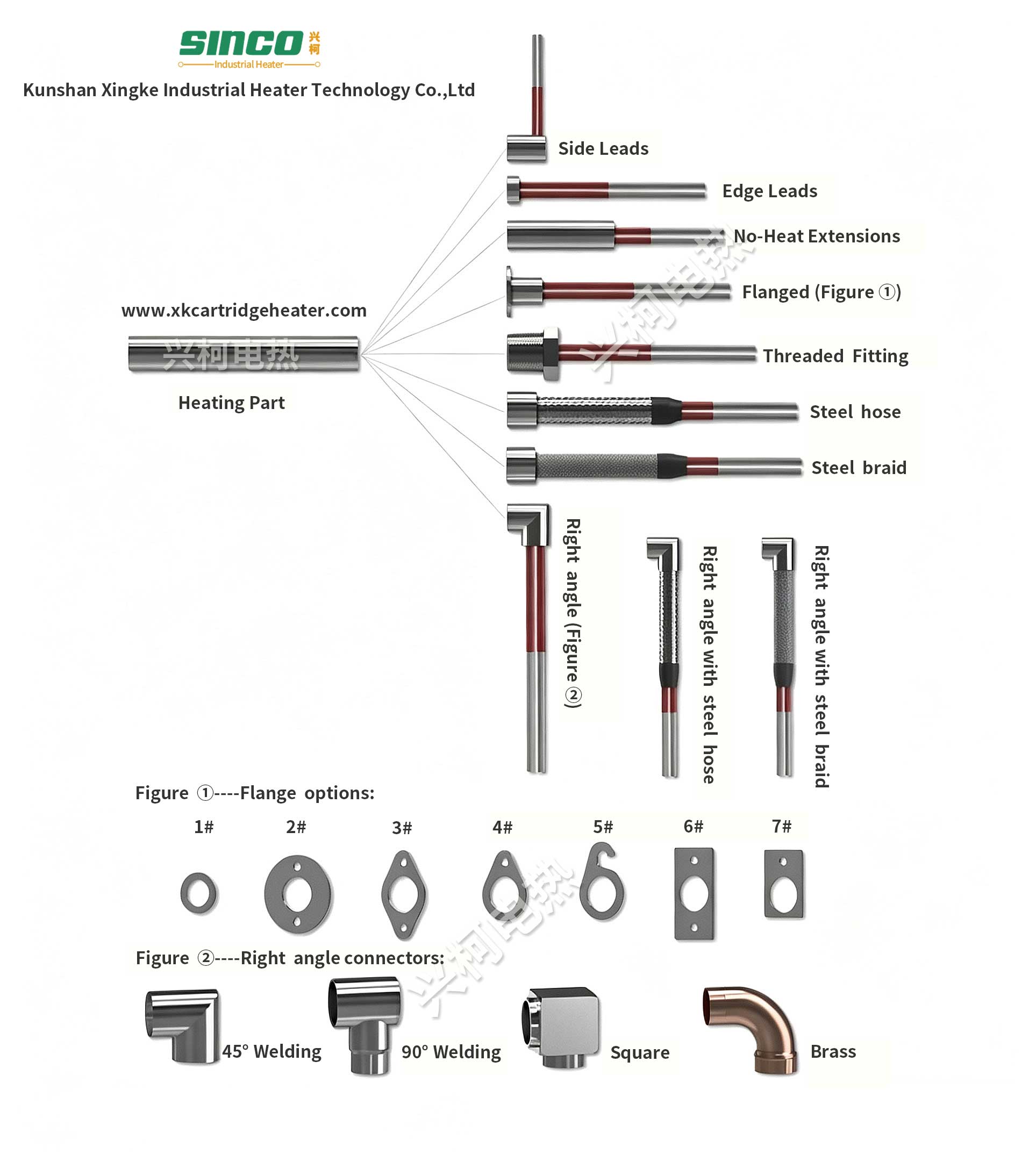
The core of selecting a cartridge heater lies in determining four key parameters: dimensions, power output, lead wire type, and material. Improper selection can easily lead to a shortened service life, burnout, or installation failure.
1. First, determine the dimensions and tolerances of the cartridge heater (this is the most critical step).
Dimensions directly impact heat transfer efficiency; therefore, one must strictly adhere to the principle of “prioritizing a tight fit”:
· Diameter Tolerance: The single-sided clearance between the outer diameter of the heating element and the diameter of the mold bore should be controlled to within 0.05 mm (for example: for a 10 mm bore diameter, select a heater diameter of 9.9–10 mm). The larger the clearance, the greater the thermal resistance, and the shorter the service life. If the bore diameter is already fixed, the heater should be custom-ordered with a negative tolerance of 0.1–0.2 mm relative to the bore diameter.
· Length: Measure the length of the heating zone (which must be completely embedded within the metal and must not be exposed) as well as the total length (including the rigid rod section at the base of the lead wires). Particular attention must be paid to ensuring that the heating zone is strictly prohibited from protruding outside the mold bore; otherwise, it will dry-fire in the air and sustain damage.
2. Calculate the power density of the cartridge heater.
Power Density (Surface Load) = Power Output ÷ Surface Area of the Heating Zone. This is the core metric that determines the service life of the heater:
· Standard Domestic Manufacturing: A surface load of 5–8 W/cm² is recommended. This option offers high cost-effectiveness and is suitable for general mold heating applications.
· Imported/High-Performance Manufacturing: Surface loads of 15–25 W/cm² are achievable. These units feature a compact size and rapid heating capabilities, making them suitable for precision injection molding or hot runner systems.
· Special Cases: When used for heating liquids or air, the power density must be significantly reduced (typically below 3–5 W/cm²), and the system must be equipped with a temperature controller.
3. Select the Cartridge Heater Lead Type
Select based on available installation space and ambient temperature:
· External Leads: The standard configuration, featuring rigid lead rods at the base that cannot be bent. Suitable for applications where the leads do not require bending after installation and the ambient temperature remains below 300°C; offers excellent cost-effectiveness.
· Internal Leads: Features a highly flexible base that can be bent freely. Suitable for confined spaces, applications requiring frequent bending of the leads, or environments with high temperatures (exceeding 300°C); offers greater durability but comes at a higher cost.
4. Select the Cartridge Heater Material and Voltage
· Material: The standard material is 304 stainless steel, rated for temperatures up to approximately 700°C, making it suitable for mold heating applications. If the operating temperature exceeds 400°C or corrosion resistance is required, 316L stainless steel or Incoloy 800 may be selected.
· Voltage: Common voltages include 220V and 380V. If the wiring configuration consists of two leads, it typically defaults to single-phase voltage; if it consists of three leads, it supports both Star (Y) and Delta (Δ) wiring configurations, allowing compatibility with both voltage levels.
5. Confirm Installation and Mounting Methods
· Axial Mounting: Secured using a locknut on the rigid lead wire stem.
· Radial Mounting: Secured by threading the end of the heating element and fastening it with a nut.
· Simple Mounting: Secured via a tight interference fit against the bore wall; suitable for horizontal installations or applications involving minimal vibration.
Summary and Recommendations: Please first provide the dimensions of the mounting hole (diameter × depth) and the supply voltage. If the heater is intended for continuous-operation applications—such as in injection molding machines or hot runner systems—we recommend selecting a model with internal lead wires and opting for either imported components or a high-density manufacturing process. Although these options may be slightly more expensive, they effectively minimize the inconvenience of frequent replacements.
What specific equipment will you be using this with? For instance, is it for a hot runner system, a mold, or liquid heating? Contact Xingke Electric Heating, and we can provide you with more tailored recommendations.